
Emirates ID OCR: The Complete Guide to Automated Identity Extraction
Emirates ID OCR extracts structured JSON from an Emirates ID in seconds: bilingual Arabic/English fields, format validation, and security checks through one API.
The UAE has led the region in digital transformation, and Optical Character Recognition (OCR) sits at the center of it. OCR converts text-based images into machine-readable data, and Emirates ID OCR applies it to the country's most-used identity document, so banks, hospitals, hotels, and government desks can read an Emirates ID in seconds instead of typing it by hand.
Manual data entry slows every one of those workflows and invites errors and security gaps. OCR replaces it with a fast, structured, repeatable step: capture the card, get clean JSON back. Here's everything you need to know about Emirates ID OCR, and how Taareef does it through a single API.
What is Emirates ID OCR?
Emirates ID OCR is the automated extraction of structured data from an Emirates ID card, returned as machine-readable JSON without any manual data entry. The system reads every field on the card and hands your application a predictable object it can store, validate, and act on.
An Emirates ID is a two-sided document, and each side carries different information, so Taareef gives the front and the back their own schema and reads both in a single API call.
The front of the card
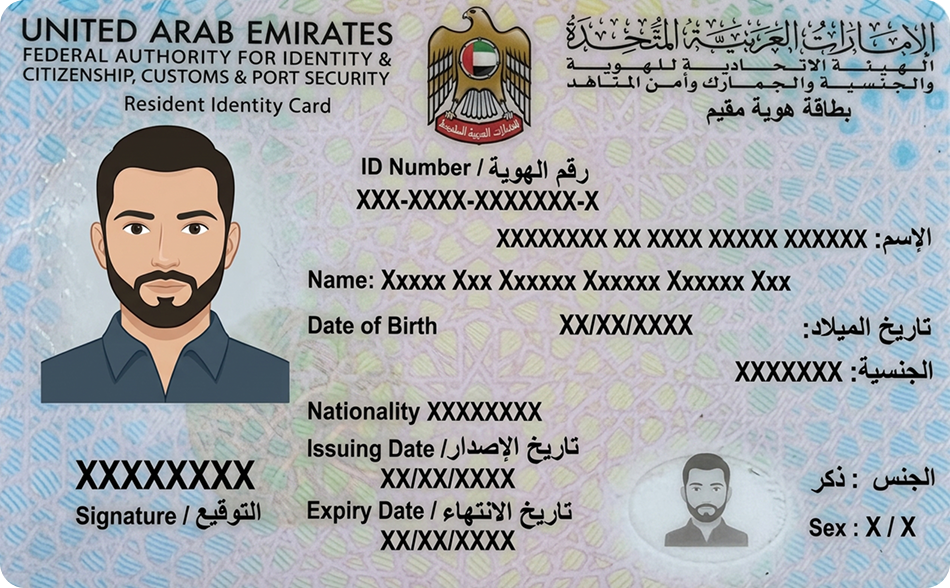
The front holds the cardholder's core identity details. Taareef extracts them and normalizes every value into a canonical form, so what you store stays consistent no matter how the card was printed or photographed:
- idNumber: the 784-prefixed Emirates ID number, formatted as
784-YYYY-NNNNNNN-C - name
- dateOfBirth, issuingDate, expiryDate: parsed to ISO
YYYY-MM-DDdates - nationality: resolved to an ISO 3166 alpha-3 code (e.g.
ARE,IND,GBR) - sex: normalized to
MaleorFemale
{ "idNumber": "784-1985-1234567-1", "name": "Khalid Al Mansoori", "dateOfBirth": "1985-03-12", "issuingDate": "2022-09-30", "expiryDate": "2027-09-30", "nationality": "ARE", "sex": "Male"}If a critical field can't be read, Taareef automatically falls back to a secondary extraction pass rather than returning a half-empty record.
The back of the card
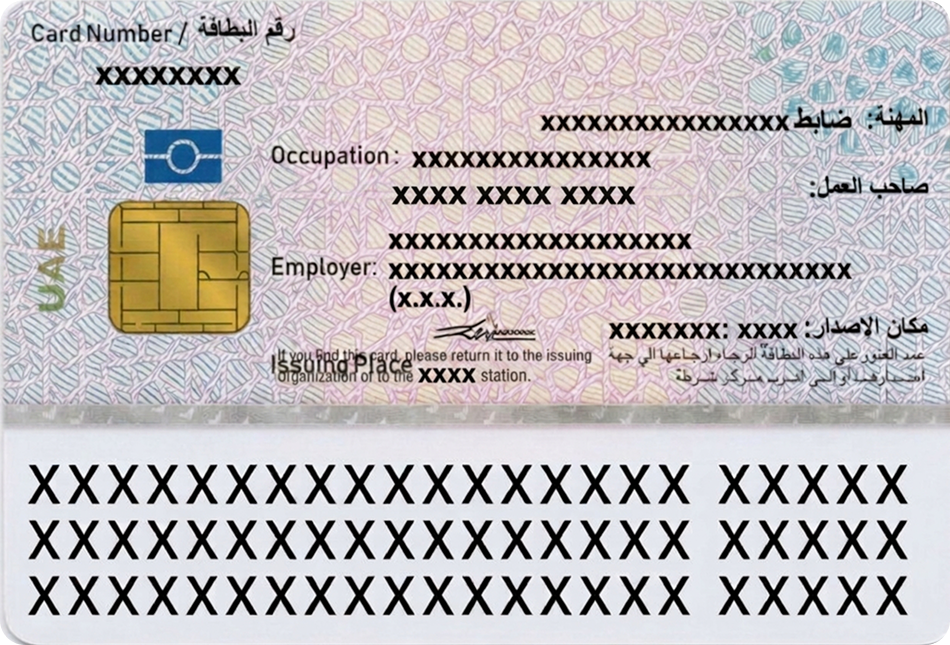
The back carries employment details and, most importantly, the machine-readable zone (MRZ): three lines of fixed-width text that encode the card's key fields with check digits. Taareef returns the raw back fields plus a fully parsed mrzData object:
- cardNumber, occupation, employer, issuingPlace
- mrz: the raw MRZ string
- mrzData: the parsed MRZ: document number, ID number, date of birth, expiry date, sex, nationality, and the holder's first and last name
Crucially, mrzData includes a valid flag. Each MRZ line carries ICAO 9303 check digits computed with the standard 7-3-1 weighting; Taareef recomputes them (for the document number, date of birth, expiry date, and the composite) and only marks the record valid: true when they all match. That makes the MRZ a built-in tamper check: if the printed zone has been altered, the digits stop adding up.
{ "cardNumber": "123456789", "occupation": "Software Engineer", "employer": "InfraNova FZ-LLC", "issuingPlace": "Dubai", "mrz": "ILARE1234567...<<KHALID<<", "mrzData": { "documentNumber": "123456789", "idNumber": "784-1985-1234567-1", "dateOfBirth": "1985-03-12", "expiryDate": "2027-09-30", "sex": "Male", "nationality": "ARE", "lastName": "Al Mansoori", "firstName": "Khalid", "valid": true }}How Emirates ID OCR works
Emirates ID OCR relies on machine-learning models, neural networks trained on a large set of Emirates ID samples. The pipeline runs in four steps before returning JSON:
- Image capture. A photo or scan of the Emirates ID is submitted; Taareef enhances and de-skews it automatically.
- Optical character recognition. Text zones are detected from the layout, and printed or embossed characters are converted into digital text.
- Language processing. Because the card is bilingual, both Arabic and English are read accurately.
- Format validation. Values are normalized, the MRZ check digits are recomputed, and the record is confirmed against UAE formats.
The whole pipeline returns in under 2 seconds on average, at up to 99.8% recognition accuracy on clear images.
Bilingual by design
The Emirates ID is a bilingual document, so it needs an engine that reads both scripts. Taareef recognizes Arabic and English on the same card, and the same engine handles more than 40 languages (French, Spanish, German, Chinese, Japanese, Korean, Hindi, Russian, and most European, Middle Eastern, and Asian scripts), so one integration covers documents far beyond the UAE.
From OCR to a full KYC check
Reading the card is often only the first step of an identity workflow. Because Taareef runs document OCR, face verification, and passive liveness detection through the same endpoint, you can extend an Emirates ID read into a complete KYC check without adding a second vendor:
- Match the cardholder photo against a live selfie
- Run passive liveness to confirm a real person is present
- Apply deepfake and spoof protection before you trust the result
One integration covers extraction, verification, and liveness, so a full onboarding flow becomes a couple of API calls.
Where Emirates ID OCR is used
Wherever identity is verified in the UAE, reading the card by hand is the bottleneck, and Emirates ID OCR removes it across every customer-facing sector.
- Banking & fintech: automate account opening and KYC, turning a branch visit into a single onboarding step that captures and verifies the cardholder in seconds.
- Car rental: read the Emirates ID and driving license at pickup, so handovers take seconds and the paperwork files itself.
- Healthcare: populate patient records at registration without a clerk retyping the card, cutting wait times and chart errors.
- Hotels & hospitality: verify guests at check-in and satisfy record-keeping rules without slowing the front desk.
- Insurance: feed verified identity straight into policy issuance and claims, with the MRZ tamper-check flagging altered cards before they cost you.
- Government & telecom: handle citizen and subscriber verification at high volume without growing the data-entry team.
Built for production scale
Beyond accuracy, Emirates ID OCR has to hold up under real traffic:
- Continuous learning: every unidentified format feeds back into the training pipeline, so accuracy improves automatically, with no releases or manual retraining.
- Zero-cost failed extractions: you only pay for successful reads; failures don't count against your credits.
- Security and residency: TLS 1.3 in transit, AES-256 at rest with managed keys and automatic rotation, network controls such as IP allow-lists and rate limiting, an optional zero-retention mode that deletes documents immediately after the response, and data residency controls including the UAE.
The business case
Automating the read step changes the economics of every workflow that touches an Emirates ID:
- Seconds, not minutes: a card that took a clerk minutes to transcribe comes back as validated JSON in under two seconds.
- Fewer errors: normalized fields and recomputed MRZ check digits remove the typos and transposed numbers manual entry introduces.
- Lower cost: repetitive verification is automated, and failed extractions never touch your credits, so you only pay for reads that succeed.
- A better first impression: customers upload a card instead of filling a long form, so onboarding finishes in one sitting.
- Audit-ready compliance: consistent, validated output and a per-request audit trail keep your KYC records defensible.
- Minutes of typing per card
- Typos and transposed digits
- You pay for every attempt
- Long forms, higher drop-off
- Validated JSON in under 2s
- Normalized fields + MRZ checks
- Failed reads are free
- Upload once — onboarding done
Why it matters
The organizations winning on customer experience in the UAE have stopped treating identity verification as a manual step. Rather than stitching together separate vendors for OCR, face verification, and multi-language support, they integrate Taareef once, and a form-filling chore becomes a couple of API calls.
That is the real shift: Emirates ID OCR is not faster data entry, it is the foundation of an automated onboarding pipeline that scales with your business while keeping every read accurate, validated, and auditable.
Frequently asked questions
Ready to integrate?
Get 100 free credits and turn any identity document into structured JSON. One API, 195+ countries, no credit card.
Keep reading
Passport OCR: What It Is and Why It Matters for Your Business
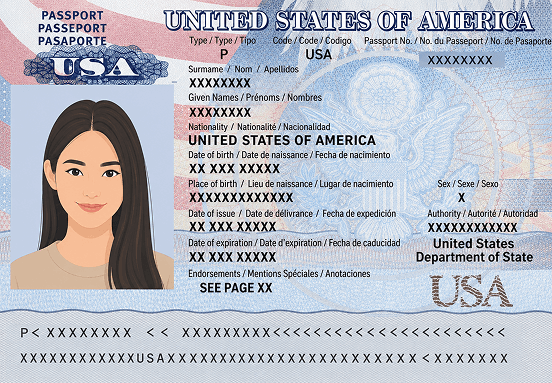
Passport OCR extracts structured JSON from a passport by reading both the Visual Inspection Zone and the ICAO 9303 MRZ, cross-checking them to flag tampering. One parser for 195+ countries.
Face Dedupe: How to Stop Duplicate Sign-Ups Before They Happen

Face dedupe is a 1:N search that compares every new sign-up's face against every face already enrolled, catching bonus abuse, referral gaming, ban evasion, and KYC re-tries that email, phone, and ID-number checks miss.